.....The Bill seeks to do a number of things that are long overdue. These include
raising the ceiling on voting rights in private banks from 10% to 26%
and, most importantly, allowing the RBI to supersede the boards of
banks. The latter is seen as an essential precondition for the grant of
new bank licences. But the government is not without blame either. The Bill introduced in the Lok Sabha differs substantially from that
cleared by the Standing Committee of Parliament, notably in that it
allows banks to enter into futures trading in commodities. If the
Banking Regulation Act, as it stands today, prohibits banks from trading
in commodities, it does so for a very good reason. It exposes banks to
excessive risks. It is best if such activities, if seen as desirable,
are confined to a separate entity under a holding company that owns the
bank as well......

The very purpose of VITALINFO is to provide a platform for wider dissemination of updated information related to and happening of events in and around RBI.
Wednesday, December 12, 2012

Consolidation of PSBs
The finance minister has again pitched for consolidation among public sector banks (PSBs). It makes sense that in this increasingly globalised environment the country will need at least two to three global-size banks that can take on greater challenges. India is an emerging market economy and corporates are going for overseas acquisitions to expand their business. Barring perhaps one or two banks, again with limited capability, no other banks in India have the required resources and ability to finance corporates for their cross-border acquisitions.........
‘Stakeholders not consulted’
A TRADERS’ association that has consistently opposed foreign direct investment in multi-brand retail is the Confederation of All India Traders (CAIT). Praveen Khandelwal, secretary general of the CAIT, was the first person to highlight the fact that one of the prerequisites to the entry of FDI in retail trade precluded the amendment of the rules and regulations of the Foreign Exchange Management Act (FEMA) through the Reserve Bank of India (RBI). The amendment was proposed by the RBI after it was pointed out by him. He had also pointed out that any proposal to amend the rules of FEMA would have to be ratified, annulled or further amended only by both Houses of Parliament. It is this issue which came up for discussion in the ongoing session of Parliament and which now has been delinked from the discussion on FDI. Khandelwal has also been relentlessly trying to convince political parties about the pitfalls of FDI in the retail sector...........
Your savings will grow, thanks to PF
Your take-home salary is set to reduce significantly, though you might end up saving more. Putting to rest the confusion regarding calculation of provident fund, the Employees Provident Fund Organisation (EPFO) has said that all allowances which are ordinarily, necessarily and uniformly paid to the employees are to be treated as part of the basic wages. Take that to read transport, education, medical and any such special allowance which is payable in cash. All this would now be clubbed to the basic salary while calculating the PF.......
Home buyers vs builders: Whose side are you on, Mr FM
...Again, the government’s stand is diametrically opposite to that of the RBI. The banking regulator has time and again warned lenders against their exposure to the real estate sector. In 2009, the RBI had increased banks’ provisioning for standard assets to 1 percent from 0.4 percent after house prices crashed in 2008 and builders found it difficult to repay loans. The central bank’s move was aimed at mitigating any asset quality risks for banks. Recently, a media report said the RBI has asked banks not to restructure real estate loans and push for recoveries instead.......
Gold Deposit Scheme: What you need to know
....While the above scheme gives 5.75% rate of return for using your gold, these jeweller schemes are not approved by any regulator (RBI, SEBI, etc) even if some jewellers may like to give such a false impression. The website www.kotharijewelry.com gives details of its GDS, but it has no mention about it being approved by the RBI or any other regulatory body. The only approved gold deposit scheme is the one from State Bank of India, but it gives very low returns and hence it is not popular with consumers......

Axis Bank plans VRS to cut flab at top
Three years after Shikha Sharma
took the corner room at Axis Bank, the country's third-largest private
sector lender is making another attempt to cut flab. The bank plans to
roll out an early retirement scheme for senior employees aged 40 or
more, who have been with the lender for 10 years or longer...........
Why Growth is still Foreign to these MNC Banks Here
With parent banks facing a turmoil in their home countries and the Reserve Bank of India’s restrictive policy on opening new branches, it’s a challenging time for foreign banks in India. Adding to their troubles is the aggressive approach of local private banks.......
Customers banking on rival ATMs piques SBI
Having the largest ATM network in India can be an enviable position. But for the country’s largest bank, the State Bank of India (SBI), that seems to be hardly the case. For, SBI has found its customers prefer the ATMs of competing banks. This has implications for business strategy, including revenue and recovering the cost on investment made in this alternate channel, according to senior SBI officials..............
Tuesday, December 11, 2012
Memo to RBI: Only shock therapy will work from now on
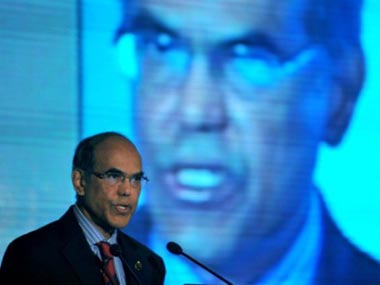 |
| Over to you, Dr Subbarao................. |
Who wants to be the RBI Guv?

IE
Hair raising........

Reserve Bank of India Deputy Governor Subir Gokarn’s rather distinctive hairstyle has attracted attention in the past, with at least one person mistaking him for a spiritual guru. He good-naturedly bore some more gentle ribbing on the subject last week, this time from R Ramakrishnan, CEO of Polycab Wires, who was speaking at an event at which Gokarn was chief guest. Ramakrishnan presented Gokarn with a book authored and published by him titled My African Odyssey – A photo journey to Kenya and Tanzania. The cover bore a picture of a lion with a wind-tossed mane. As he handed him the book, he looked askance at Gokarn’s wife Jyotsna Bapat and said the next time Gokarn had a bad hair day, she could remember this book because he would look just like that lion on the cover.
BS
Existing laws don’t allow interest on CRR: Chakrabarty
......Explaining the rationale behind the regulatory mandate, the Deputy Governor, who looks after banking supervision, apart from a host of other departments at the central bank, said the CRR is charged on banks because only they can create money. “Who creates money?...It’s only bank deposits that too chequeable deposits or demand deposits that create money. That’s why CRR is imposed only on banks...if a bank gives money to NBFCs, it will go not to NBFC but to some bank accounts (of NBFCs),” Chakrabarty, who recently got a two-year extension, said........
Deciphering the Euro Zone crisis - V. K. SHARMA
Edited excerpts of the keynote address delivered by V. K. Sharma, Executive Director, RBI, on November 30, at the International Leadership Symposium organised by World Forum for Ethics in Business in partnership with World Bank Institute at European Parliament, Brussels. Belgium.

.....in sustainable globalisation, there can be both winners, and losers, only in the short term, for such is the nature of sustainable globalisation that, in the long term, there can only be all winners and no losers. Therefore, if we earn and share, we prosper together, and if we don’t, we perish together.......
Read - HBL
No info on flaws in Samagra Gramin Vikas Yojana: RBI
The Reserve Bank of India (RBI) has no information on irregularities, if any, in its Samagra Gramin Vikas Yojna being implemented in 115 villages across the country, as per its reply to an RTI query by rights activist Radhakanta Tripathy. The main purpose of the scheme is financial inclusion, financial literacy, maximising relationships, extending community outreach and reiterate to the banks and other financial service providers and local authorities of the significance and seriousness that the RBI attaches to provision of financial services and financial education, the RBI has said. It said that visits by its top management have been undertaken in 2009 as an initiative for rural development in the platinum jubilee celebrations of the RBI. Replying to a query as to whether performance appraisal had been carried out annually on the development of the villages adopted so far, the RBI said that the performance of these villages is monitored with a quarterly report.............
Financial Inclusion by Central Bank of India in E. Godavari dist
......In the ultra small branch, people could open accounts with zero balance. According to the RBI's directives, the transaction would be conducted through the branch, said Mr. Tanksale. East Godavari district had been chosen as one of the 51 districts in the country for carrying out cash transfer scheme of the Union Government from January..........
RBI’s big challenge is to deepen financial inclusion: Gokarn
The monetary and financial policies of the Reserve Bank of India must be guided towards financial literacy, said RBI Deputy Governor Subir Gokarn on Monday. Addressing an outreach programme conducted at Mudageri village in Karwar taluk by the RBI on Monday, Dr. Gokarn said the programme was to create financial awareness among rural masses. It was the 11th programme in the series in the State. The Deputy Governor said he was privileged to hail from Uttara Kannada district and thanked the people for allowing him to participate in a programme which envisaged financial inclusion of rural masses........
......Uma Shankar, Regional Director of the RBI, said the programme aimed at inculcating the habit of saving money among teenagers. The RBI had chalked out many programmes to encourage talent among students. She said that women’s self-help groups were funded by banks to create financial independence and they should avail the benefit. ......
Economically speaking
Sarla Anil Modi School of Economics, a constituent school of NMIMS, deemed-to-be-university organised its annual Economics Conclave last week, where RBI Deputy Governor, Dr Subir Gokarn, addressed the audience. The theme of the conclave was ‘Indian Economy – Navigating Choppy Waters’. It saw participation from students who got an insight on the Indian economy and the challenges it faces. The key note address delivered by Dr Gokarn was about managing inflation and the challenges for the Indian Central Bank........
Banking on general managers
Not just investment scare which is holding up sanction of loans in public sector banks, this is the time when General Managers become Executive Directors and from there to CMDs. The last thing anyone wants at this stage is a loan application going bust. So all high value credit applications will remain pending till the appointment orders come through this month.
IE
IE
Reserve Bank of India simplifies account opening norm
...."If the address on the document submitted for identity proof by the prospective customer is same as that declared by him/her in the account opening form, the document may be accepted as a valid proof of both identity and address." The banking regulator said in a notification issued to banks on Monday. The RBI has also clarified that since introduction is not necessary for opening of accounts under PML Act and Rules or Reserve Bank's extant KYC instructions, banks should not insist on introduction for opening bank accounts of customers......
Urban cooperative banks have maximum potential to reach out to common people: Malvika Patel
PUNE: Urban cooperative banks have the maximum potential to reach out to the common people, said General Manager of the urban cooperative department of the Reserve Bank of India, Malvika Patel. Speaking at the inaugural session of a training programme organised jointly by 'Galaxy Consultancy' and 'Banko Diary', Patel said that the number of private and commercial banks in the country is increasing but urban cooperative banks have the maximum potential to serve the common people. The training programme was held for officers and directors of the cooperative banks about the modern processes, technological developments and rules. ...........
Co-op bank staff body holds protest to press for demands
....Developing co-operative consciousness among the various stakeholders of cooperative banking structure; exempting smaller co-operative banks from the income tax net; capital infusion in weaker co-operative banks and closer co-ordination between Reserve Bank of India and Government Registrar of Co-operative Societies are some of the key demands of the Federation......
Make MFI interest rates consistent with repayment capacity: C Rangarajan
....."Fix interest rates in a manner in which it is consistent with the repaying capacity of the borrowers. Now, fixing the interest rate independent of the repaying capacity of the borrower is asking for disaster. "I think that's where things went wrong," Rangarajan said during a programme in Centre for Economic and Social Studies. ......
Finance Ministry pushes RBI to give infrastructure status to housing sector & ease provisioning norms
NEW DELHI: The finance ministry has asked the Reserve Bank to consider giving infrastructure status to the housing sector, and relax provisioning norms for it so banks can extend attractive loans to buyers. RBI has mandated that banks set aside from their profits an amount equal to 1% of total standard assets in commercial real estate, which also includes housing projects. This means if a bank lends 100 towards a commercial real estate project, it will have to keep aside 1 to offset any loan to the sector turning bad. The provisioning rises to 15% of net investment in case of secured sub-standard asset. A finance ministry official confirmed the government has asked RBI to look at all possible options to provide an impetus to the housing sector...........
Traffic diversions jam major roads
BHUBANESWAR: Commuters in the city had a harrowing time negotiating traffic diversions following the stir by Gana Sikhyaks at Lower PMG Square here on Monday. The vehicles remained stranded for nearly two hours at the intersection with not a single traffic cop in sight. Most vehicles turned off the engine near the Reserve Bank of India after being diverted from the Lower PMG. The commuters had to take a detour from the back side of the bank negotiating traffic coming from the opposite direction. .......
Banking Bill hits Opposition wall, stalls on procedural issue
A determined Opposition on Monday thwarted the Banking Laws (amendment) Bill 2012 in the Lok Sabha, raising doubts about its being passed in the coming days. This Bill was listed for consideration and passage in the Lower House on Monday. Monday was, however, a mixed day for banking reforms, with Finance Minister P. Chidambaram succeeding in getting a Bill on debt recovery passed by the Lok Sabha. The Bill (recovery of debts) was passed after the entire Opposition staged a walkout over it not having been referred to the Standing Committee. On the Banking Laws (amendment) Bill, senior Bharatiya Janata Party leader Yashwant Sinha demanded that three new provisions sought to be introduced by Chidambaram be first referred to the Standing Committee on Finance......
India’s growth story: A comparative view
As GDP growth slows and industrial performance worsens, the government is hard put to find explanations. Part of the blame has been conveniently placed at the door of the central bank, with fingers pointed at the Reserve Bank of India’s reluctance to cut interest rates that were raised to combat inflation. But the more fundamental explanations being offered are the poor performance of the global economy and the difficulty of pushing ahead with more “reform” in India’s divided polity. Since little can be done about the former, the Congress Party’s economic policy agenda has been focused on accelerating reform at all costs, with special attention on policies that favour foreign capital..............
Need 2% rate cute by RBI for growth to come back on track: Nandan Chakraborty, Axis Capita
....Well, it is a mix of everything. If it is left only to the RBI to revive growth, they would not be able to do it at all. Historical trends indicate that you need at least 2% cut in the interest rates to be able to revive growth back to trend line. On the other hand, if you do that, then the inflation shoots up........
RBI unlikely to cut rates on Dec 18: Report
.....Over the past three months, the Reserve Bank has reduced the cash reserve ratio, the portion of deposits banks are required to keep with RBI, by 0.50 per cent to 8 per cent. But these cuts did not lead to an easing of overnight rates. Though the RBI has finally decided to resume open market operations (OMOs) to ease liquidity, BofA ML said that “Governor Subbarao may not want to take chances with the RBI’s inflation fighting image by cutting rates at 7.5 per cent inflation.” India is the only BRIC where lending rates are almost at their 2008 peak, the report said......
Do RBI rate cuts really matter to the common man?
......So let us stop making fuss of the credit policy or its supposed failings. It’s time now that RBI needs to improve on making the formal source of credit available to common people easily. The Reserve bank should now make the most of the opportunity offered by Aadhaar-based cash transfers so as to enable a full-fledged mobile banking across the country. Also they need to implement new licenses between the banks and the phone companies so that the method of formal finance reaches any and every body across the Indian Territory. Not only this, RBI should take steps so as to make policy rates more relevant to more people.
Read.......
To control inflation, use structural reform
.......Assorted blunders add to the chaos, eg, judicial rulings that contravene the sanctity of contracts, and misguided institutional action, like the Reserve Bank of India (RBI) trying to force the government towards fiscal responsibility instead of concentrating on providing stability and support for growth. This is aggravated by a government that does not seem to act in the public interest, and a frustrated Opposition that stalls governance and parliamentary proceedings............
FAPCCI seeks drastic cut in interest rates
....The Federation of Andhra Pradesh Chambers of Commerce & Industry has urged the Reserve Bank of India for a higher percentage of interest rate reduction to boost industrial production. “Given the current industrial and economic scenario, there is an urgent need for the RBI to reduce interest rates not by a token of 25 or 50 basis points, but by 200 basis points,” the trade body said in a letter to the RBI Governor......
The wages of growth in India
.....The question is: which set of numbers is correct? This is not merely an academic question but has important implications for policy decisions. In recent months, GDP numbers have been stealthily revised down, RBI has expressed reservations about the industrial production data and now the data on wages, too, is cause for confusion. It’s high time for a complete overhaul of our macroeconomic data collection systems. Is the Indian economy experiencing a wage depression?
Why India’s gold fever isn’t easily cured?
..Moving a step further, in October, the RBI barred banks from financing the purchase of gold in any form other than working capital finance. RBI is only “trying to cure the symptoms rather than the problem,” said Rajeev Malik, senior economist, CLSA Singapore. “There are several drivers of India’s demand for gold, including a convenient store for unaccounted wealth, use as an inflation hedge and rising demand for investment in gold,” Malik said. “The push towards unlocking of this vast reservoir of gold savings is a welcome step and could be marginally effective.”.........
Inflation, not gold, is problem
........Finally, gold has maintained value against inflation. In the last five years, as inflation climbed higher, fixed deposits or small savings schemes have not kept up, earning investors a negative real return. Equities, which are supposed to beat inflation, have proved a disappointment, too. To some extent, gold demand will dampen as the economy starts picking up, as investment opportunities open up and as inflation falls to reasonable levels. But there is bit of chicken and egg here: strong gold demand weakens rupee, weak rupee pushes up inflation which then causes another rush for gold.........
Robbed by cyber criminals, Kandivli man to approach telecom authority
.....Cyber lawyer Pankaj Bafna said, “Landing of bank correspondence in wrong hands could prove to be dangerous.” The Reserve Bank of India (RBI) has made sending of the know your customer (KYC) forms mandatory since April. “A person may have shifted his residence, but does not inform the bank about it. Hence, the KYC forms are sent every three years so that the customers can update their details. This could ensure that sensitive data does not land in wrong hands.” Experts advise caution while uploading details of your e-mail account on a networking site.....
Public cash holdings rise by Rs 44,000 cr
.....With at least five states headed for the elections beginning with Gujarat on Thursday, currency with the public jumped by Rs 44,000 crore in a single fortnight. Currency with the public according to the RBI data amounted to Rs 11,08,120 crore for the fortnight ended November 16. Currency with the public represents cash holdings with the public......
Electronic transactions rise 30 per cent till October: RBI
....The banks, especially the foreign banks operating in the country, have started aggressive marketing of credit cards even outside the banks’ customer base. The practice was followed by banks before the crisis year of 2008 and was stopped thereafter.
Banks See New Charge in M-Banking
....In a
country like India, where there are only 90,000 bank branches and
banking services reach only about 40% of the population, the need to
open more branches is compelling. Mobile banking, backed by a robust
banking-correspondent architecture, overrides the need to set up more
branches. “Mobile banking will help lot of customers who are financially
excluded,” says Sabharwal. It also works for banks because a physical
bank is expensive......
FinMin: Use e-payment route to beat disruptions at branches
....The Finance Ministry, it appears, wants to make sure that calamity, strike or other disruptions at banks/branches don’t disrupt revenue collections. The Ministry has asked members of the public to use alternative channels such as ATMs, Internet, and other electronic means to pay tax and other statutory dues in case of any service disruptions at the bank/branch in handling government business.......
Union Bank launches Xperience branch in Kolkata
....Union Xperience branches are a part of the bank’s initiative towards bringing superior customer experience for its customers. The bank has introduced automation through self service machines like pass book printers, cheque deposit machines and queue management among others and also completely revamped the sales and service model in these branches, said a bank press statement. The bank also launched its green banking service at the branch,.....
Monday, December 10, 2012
Monks of Mint Street
 |
| The five mantras of the old monks of Mint Street are simple but sagacious |
It is rare to get four exceptionally important policymakers—all being architects of post-reform monetary structure and policy in India—on the same stage. Something like this happened recently in Mumbai when three former Governors of the Reserve Bank of India (RBI) and the current head engaged in a freewheeling discussion from the same platform. As none of them was a career central banker, the group could not have been more diverse in terms of the style and substance of their trade...........
Seminar on 'Future Challenges of Banking in India' held
Bhubaneswar: The Regional College of Management (Autonomous) conducted a Seminar on ‘The Future Challenges of Banking in India’ here on Friday. The chief guest of the occasion was Harun Rashid Khan, the Deputy Governor of RBI. On this occasion, RCMA and HDFC bank, as a part of Corporate Social Responsibility and Institution Social Responsibility, organized a Blood Donation Camp in the RCMA campus......
No harm trying a policy rate cut, says SBI’s finance chief
There will be no harm if the Reserve Bank of India cuts policy rates to support growth, said Diwakar Gupta, Managing Director and CFO, State Bank of India. Since raising interest rates 13 consecutive times did not work in controlling inflation, lowering rates may not harm either, he added............
Shift+Deleted..............
Shri.P.Easwara Menon, retired Manager from Thiruvananthapuram Office, passed away in Alleppey on December 7, 2012. He was 65 years old and succumbed to a massive heart attack. He was an expert in Computers and Software and his knowledge was fully utilised by DSIM and DIT, Mumbai .
- As reported by P.P.Ramachandran (via e-mail)
Religious soul departed........
Shri.C.B.Meherchandani died of heart attack on November 11,2012 in Mumbai. He was 71 years old and retired as Grade B Officer from DEBC in 2001. He was a deeply religious person and a keen Television mechanic--which was his hobby.
- As reported by P.P.Ramachandran (via e-mail)
Medical treatment proved no guarantee.......
Shri.Padmanabha N Karkera died on December 3, 2012. He suffered from respiratory ailments. He died in Mangalore, where he was taking medical treatment in Manipal Hospital. He retired from as Deputy General Manager from Deposit Insurance and Credit Guarantee Corporation, Navi Mumbai. He had opted for voluntary retirement. He was 66 years old.
- As reported by P.P.Ramachandran (via e-mail)
Rangarajan cautions against sharp changes in tax policies
Uncertainties in tax policy should be minimised, at least in the short-term, and forward-looking changes be made only in the medium-term, said C Rangarajan, chairman of the Prime Minister's Economic Advisory Council. His comments came while the government is reviewing amendments to the Income Tax Act and the General Anti-Avoidance Rule ( GAAR). “The investor should be confident enough that no sharp changes are likely to be there at least during the implementation of the project,” Rangarajan said at a seminar on tax reforms and tax administration..........

VTA Demands Gradual Implementation Of CTS-2010 Cheques
...........Accordingly VTA has send memorandum to Union Finance Minister P. Chidambaram and RBI Governor Duvvuri Subbarao specifically appealing that such move should be made applicable gradually to avoid needless legal litigations and erroneously breach of trust within the parties. Implementing such a move over night shall cause unwanted multiple cheque bounce cases as many account holders still possess old cheque books and weak awareness shall enhancement problems after 1.1.2013, hence VTA demanded withdrawal of such RBI circular dated 3.9.2012.
'Realign production structure to bring in more protein’
......“There has been a change in the structure of food shortages in the country. We seem to have got into a situation where food prices are being driven by a particular segment, primarily protein prices including milk, egg, fish and meat,” he said. Higher food inflation also tends to tilt the growth-inflation balance to more on the inflation front. “So managing inflation tends to become a challenge,” he said. Lower food inflation will improve the growth-inflation balance,.........
Fake money menace on the rise in Vizag
......Almost all banks take adequate precautions before refilling ATMs in order to prevent such complaints besides curbing circulation of counterfeits, said State Bank of India deputy general manager (business and operations), Manoj Khattar. He said that so far as SBI's Visakhapatnam zone was concerned, no complaints had been reported so far on receipt of fake notes from the bank's branches. As per RBI guidelines, Forged Note Vigilance Cells (FNVC) have also been set up at the head office of various banks to closely monitor fake note cases, a senior bank official said..........
Reaching ATMs an uphill task for disabled
........All India Bank Employees' Association of India (AIBEA) general secretary C H Venkatachalam said banks are yet to follow the RBI instructions. "It's unfortunate that most ATMs don't have facilities for the physically challenged. Many disabled people have their salary accounts in these banks and have to use ATMs," he said........
No bank account for people with disabilities
....It is also learnt that pursuant to a communication from the National Trust Act (for Autism, Cerebral Palsy, Mental Retardation and Multiple Disabilities) unit, the RBI did send out a circular advising banks to rely upon guardianship certificates issued under the Mental Health Act or the above Act for opening/operating bank accounts. Besides, it also makes recommendations on improving customer service in banks to various categories of disabled people........
KYC norms have made investments in financial instruments all but impossible
Janmejaya Sinha, chairman for Asia-Pacific at the Boston Consulting Group, described in graphic detail his travails trying to establish his identity after he’d shifted to a new address in the same city. Well, that was before the recent tightening of know-yourcustomer (KYC) norms and Sinha at least had the consolation that he’d moved to a new and, presumably, better accommodation . There is no such consolation for millions of others who will have to endure similar, if not worse, travails; thanks to flawed KYC norms..........
Read - ET
Read - ET
RBI may hike NPA provision ratio if needed: Chakrabarty
.......Speaking about NPAs of banks, Chakrabarty attributed a majority of them to poor administration and risk management practices of lenders and went to the extent of terming it as 'non-performing administration.' "I call NPA as non-performing administration. We have to make the administration functioning," Chakrabarty, who oversees banking supervision at RBI, said. The RBI Deputy Governor said the "change in the administration" has to come in a slew of areas which would be internal as well as external. Lending rates would have been far lower if banks had got their NPAs down, Chakrabarty said. "It is a burden on the people who are paying the money. People forget that if NPAs would have been 1%, banks' lending rates would have been 4% lower with the same inflation, and same repo rate. "That's why we should tackle NPAs -- not only for the survival of the system, but also for the survival of the customer," Chakrabarty said............
RBI should reconsider provisions of master circular on export of goods and services
.........RBI issues a fresh Master Circular every year incorporating the changes made during the previous year. However, it does not help to retain year after year the provisions that are illogical or too complexly worded. RBI must also review the necessity to retain outstanding or export proceeds due as the basis for determining eligibility. A better basis would be export performance or outstanding beyond the permissible period.
Social costs of the global economic crisis
.....ndia's export growth which had lost momentum in the second half of 2011- 12, mainly owing to slow- down in external demand has shown further deterioration in 2012- 13. Exports in April- September 2012- 13 declined by 6.8% as compared to the level during the corresponding period of 2011- 12. There was considerable decline in exports to the Euro area. A more demonstrable case of external sector affecting India's growth is the risks from the impending US " Fiscal Cliff". As the RBI puts it. " A major downside risk to global growth is now looming from the US fiscal cliff. The US Congressional Budget office forecasts that the US fiscal deficit will decline by 3.3 percentage points to 4% of GDP in 2013. Such as sharp fiscal consolidation may have a deleterious impact on global growth. There could be an adverse impact of the US fiscal cliff on India's growth. If global growth slumps there would be spilled over impact on the current account as well……." It now seems difficult for India to attain even a 5% GDP growth in 2012- 13. Thus the full impact of the global financial and economic crisis on the Indian economy is now manifesting itself........
More action in Parliament
.....While the original Banking Laws (Amendment) Bill had specific provisions to take banking mergers out of the competition watchdog’s ambit, there has been talk also of the Government wanting to drop that exemption clause. The RBI, in turn, has fiercely opposed such a move. Whether it is the RBI or CCI that will have the ultimate say on bank mergers and acquisitions would be clear from the final version of the Bill that gets tabled on Monday.......
India is suffering from inertial inflation A.Seshan
“It’s a systemic crisis that India is going through.” — Bimal Jalan
As the markets eagerly await the Reserve Bank of India (RBI’s) mid-quarter review of its policy, the controversy over price stability and growth needs to be understood in the proper context. Economists are fond of using terms from physics to make their discipline look scientific. The concepts of “equilibrium”, “velocity”, “acceleration”, among others, were thus conceived long ago. A more recent entry is “inertia”. It would mean that the economic system gets stuck at particular levels of economic variables, owing to the absence of forces to disturb the state of equilibrium. “Inertial inflation” is one such concept. It refers to a situation when the rate of price increase attains a stable equilibrium, where it remains until a shock is administered to move it to a new position........
Mixed signals from RBI on rate cut, inflation
Reserve Bank of India (RBI) is keeping the nation guessing on prospects of an interest rate cut in the mid-quarter review of monetary policy scheduled for December 18 by giving mixed signals on inflation, which determines the central bank's stance. Deputy Governor Subir Gokarn on Saturday said inflation continued to be primary concern for the central bank. But only two days earlier, Governor D Subbarao said he expected inflation to come down from January and will consider the growth-inflation trajectory in framing monetary policy - which suggested a benign expectation....
India’s battle with inflation: Just a phase I was going through
.....Critics argue that the RBI has already been cutting by stealth, using liquidity-management tools and verbal guidance to make sure market interest rates have dropped even as the policy rate has stayed unchanged since March. Ditching the inflation target would, by this account, just be an admission that it never had the stomach to enforce it in the first place. The RBI would put things differently. Although its empirical work has previously suggested that 5.5% is the maximum healthy level of inflation, lately something has changed. Despite a sharp economic slowdown prices have kept on rising. A big chunk of demand seems to be insensitive to what the RBI does. The government borrows regardless. Rural consumers, who are doing well and are often outside the formal financial system, are shifting to richer diets, pushing up food prices. That leaves the RBI with a lousy option,......
Rising wages offsetting inflation, says Gokarn
.......“Why is high inflation not generating same kind of unrest or outrage that it used to historically?” Gokarn said, adding that “an important answer to this could be that rural wages have actually been rising by about 20 per cent annually for the last five years.”......
Read - IE
Inflation is key worry for RBI, says Gokarn
MUMBAI, DEC 8:
The Reserve Bank of India’s monetary policy signal is to control inflation as it will support growth in the long term, said Subir Gokarn, Deputy Governor. “It is very important for people — consumers, investors and stakeholders — to have some confidence in the system’s commitment to lower inflation,” Gokarn said at the Bombay Management Association’s 15th Finance Convention............
Consolidation needed in banking sector: Central Bank CMD
..... Indian banks were nowhere in the global list of big banks and therefore it was preferrable that mergers should take place to achieve size and compete in the global market. “Our Finance Minister has expressed the wish that consolidation should take place in the banking sector, but it is not happening. When two banks come together, there should be compatibility in organisational cultures and there should be technological convergence — objectives which are difficult to achieve, but by no means impossible,”........
States should amend cooperative laws: Pranab
...“By this amendment the right to form cooperative society has now become a fundamental right. The act has paved the way for development of a stronger cooperative movement. To take this initiative further to the grassroot level respective state governments also need to create enabling environment by amending state laws etc as and when it is necessary,” Mukherjee said after giving away the National Cooperative Development Corporation (NCDC) Awards for Cooperative Excellence 2012 at Rashtrapati Bhavan on Saturday...........
Basel bonds flop in India
........“The transition to Basel III is not coming at a good time for Indian banks, as they are facing asset-quality issues and the overall business outlook looks grim,” said another banker. There are several hurdles to these new bonds in India, not least being the lack of understanding on the buy side. The loss-absorption features required for sub bonds to count towards Basel III capital may put the paper beyond the reach of investors like pension funds and insurance companies, if their funds are not allowed to invest in equities. To qualify as additional Tier-I or Tier-II capital, bonds will need to write down to zero if the Reserve Bank of India (RBI) deems a bank to be non-viable, forcing sub bondholders to wear losses before any public funds are used in a bail-out........
At 3 crore rural accounts, banks set global record
The banking sector has opened over three crore accounts in rural India as part of their financial inclusion drive. Compared to the number of rural households in the country of over 22 crore this is about 13 per cent. The government data upto March 31, 2012 also shows the extent to which the banking sector has to stretch to make the Aadhaar programme a success.........
When will HDFC merge with its bank? Well, er....
.....In short, even the father tacitly agrees that the only thing holding back a merger is the regulatory requirement. The Reserve Bank of India (RBI) mandates that banks have to keep aside a certain percentage of their liabilities (a.k.a. deposits) as cash reserve ratio (CRR, 4.25 percent now) and another 23 percent as SLR (statutory liquidity ratio) – something that housing finance companies don’t have to bottle up needlessly.........
How Saraswat Bank beat the odds?

As farmers suffer, NABARD offers soft loans to corporates
.....NABARD’s response to a RTI query reveals that it released Rs 13.3 crore BCG for a ‘repositioning’ report that it admits has never been submitted. Sources in NABARD allege that an additional payment of Rs. 9 crore has also been released to “rollout the recommendations”. NABARD Chairman Prakash Bakshi, under whose leadership these transactions were sanctioned, did not respond to detailed questions that were emailed to him on December 3, including on the fresh release of Rs 9 crore to BCG or what hit NABARD’s balance sheet was likely to take after the repayment to RBI of the unauthorised fund transfers to corporates.......
Rs. 37 crore handed out for publicity
Prakash Bakshi was made the Chairman of NABARD despite serious vigilance cases pending against him during his tenure as the Executive Director, NABARD. One case pertained to the release of Rs. 100 crore on 31.12.2008 to Andhra Pradesh Cooperative Bank (APCOB) as a clean advance, which is not allowed as per NABARD’s policy and therefore illegal...........
SBI will continue to grow ahead of the industry

.....I would not comment on others. But for us savings bank growth is phenomenal. We have not been dented by increase in savings bank rate by some of the smaller private sector banks. We have a huge distribution network. Even if these banks offered higher savings bank rate, how many people they have reached out to? Secondly, if return is the issue we offer a 6.5 per cent return on a seven-day deposit. So we think that saving bank is not an instrument for return maximisation. Savings bank is an instrument of convenience for payments. We have done a number of things outside the deposit rates. We have made multi-city cheques available to all customers at no extra cost........
Saturday, December 8, 2012
Walk the extra mile to become employable, students told
 |
Success Mantra |
.......“There is no substitute for hard work,” Chief General Manager in-charge, Reserve Bank of India, G. Jagan Mohan Rao, said and called upon the students to have confidence in their capabilities. He explained the working of the Reserve Bank and the money markets. “There is nothing wrong in changing jobs for money, and there is no real loyalty to the employer. But, what is required is loyalty to the job on hand. Do it and properly,” he emphasised.......
Subscribe to:
Posts (Atom)